*
Published on Yahoo! Finance, June 12 and June 26, 2006
How to Succeed in Hollywood -- and Anywhere Else
by Ben Stein
Monday, June 12, 2006
On June 30, 1976, when Gerald Ford was President and we were just getting over Vietnam and Watergate, I opened my eyes in my apartment in New York City and closed them in Hollywood in a very cool hotel called The Sunset Marquis. My plan was to sublet my place in New York, work for six months or at most a year in Los Angeles, and then go back east.
In a couple of weeks, it will be 30 years, and I'm still here. Now, for the past many years I mostly travel around, speak, write about finance (which was my training), appear on TV about money and finance, and do commercials.
But for many years, I worked in Hollywood as a writer, producer, and actor. I got to see what works in terms of success here and what flops. Comparing that experience with what I've seen of journalism, finance, government, and sales, it's clear to me that what helps you make it in Hollywood is pretty much what helps you get ahead generally in any business.
So, since I'm mentally always lecturing the way I did in "Ferris Bueller's Day Off" -- only a little more interestingly, I hope -- I sat down with my long-time best friend, Al Burton, a successful producer here, and churned out a book about how to succeed in Hollywood or anywhere else.
Now, I usually write about investments, and I will again. But for most of us, our main earning asset is our selves. We make much more from our labor than from our investments unless we're in a super rarefied stratum. If we work smart, operate with an eye on what works, we get ahead and make a decent livelihood.
So, herewith are a few deathless words about 26 Steps to Succeed in Hollywood, or Any Other Business. This a two-parter -- click here for the second part ("Wise Words for Getting Ahead in Your Career").
Learn a Useful Skill
You get paid for applying makeup or writing a script or lighting a stage or catering a crew's lunch. You have to have a specific skill that Hollywood needs, and you must have developed it to a level that makes the studios or networks want to hire you.
Make Yourself Invaluable
Do your work with such zeal and quality that your employer realizes he or she must have you at work every day to get everything that he needs done in a day accomplished. Don't be a slacker or waste your boss's time or anyone else's. Do your work so that when you leave, your employer says, "How did I ever get along without her?" Be that good every day, and you'll become invaluable -- and you'll get paid as if you were.
To Serve Is to Rule
This was suggested to me by my friend Barron Thomas. If your work on behalf of the costume department head is so good that your boss looks great and can brag about her department, you gradually become not the servant but the master. If you're a beginning chanteuse and your agent wants you to sing Hava Negila at her son's Bar Mitzvah, do it -- and do it so that everyone in the room is on the floor dancing. Then you'll get nightclub gigs.
The agent serves the client. The writer serves the producer. The hairdresser serves the star. The producer serves the studio -- and most important of all, the studio serves the audience. "Everybody's got to serve somebody," as Bob Dylan, the greatest poetic genius of our era, sang. If you serve well, you eventually become the boss.
There Is No Quitting Time
If you work at the Postal Service, there's a quitting time. If you work in a coal mine, there's a quitting time. If you work at Tara in "Gone With the Wind," there's a quitting time.
But you don't have a life outside of Hollywood. Hollywood is your life. Your career is your life. You work until you've done as much as you possibly can, then you read a script, and then you go to sleep. That's your life.
Connections Are Everything
You don't get ahead in Hollywood by taking the Hollywood SAT's. You get ahead by being noticed by the people who are already ahead. You can go to the best film school in America and get super grades, but if you're not a pal of the movers and shakers, you can just forget about everything you've learned inside the ivy-covered walls
The landscape architect who does a great job on the studio boss's pool area and has a script has a much better chance than you do coming from New York University's film school without a friend in town. (Of course the best film schools often provide connections as part of the degree, but not always, as I can assure you.) You'll do better as a waiter who serves the big-shot agent his pepper-crusted tuna piping hot at Morton's than as the winner of the acting contest at a Big 10 University.
Make connections any legitimate way you can, shine them up nicely, and you'll be a happy guy or gal.
There's No Such Thing as Being Too Likeable
Remember how it was in high school? The friendliest, most self-confident kids got to be chairman of the student council and had a crowd hanging on them. Well, it's exactly like that in real life in Hollywood (or anywhere else). Men and women gravitate to those who are likeable and easy to be around.
Think of your own bad self. Who do you like to be around? Sourpusses or friendly, encouraging, smiling people? That's how it is in the workplace, too.
Your likeable self is the self who gets ahead. Remember it, and win in Burbank, Beverly Hills, or Bergen County.
Well, that's enough for now. I'll give you more in my next column. Remember, I have seen this, and it works. The people who have the Aston-Martins and the houses in the flats of Beverly Hills know it, even if the wannabes at Starbucks don't.
[PART 2]
Wise Words for Getting Ahead in Your Career
by Ben Stein
Monday, June 26, 2006
As you will recall, class, last session we were discussing how to succeed in Hollywood...or any other business, based on my long years -- 30 years as of June 30 -- toiling here in Lotus Land.
Here's Part 2 of my tips on how you can advance in your career -- with the strong admonition that for most of us, how much we earn by our labor is far more important and a larger sum than how we earn with our investments. Thus, it pays to maximize your utility (as we economists say) by working smart.
Stay in the Game
Don't let temporary pique or anger toss you off your horse. People will be rude to you. They will cheat you. They will disappoint you. Nevertheless, stay on your horse -- or get back on it -- and stay in the game. Unless you have an excellent alternative -- a better way to pay your bills and fulfill your dreams -- stay in the game. This takes a lot of forbearance and swallowing of pride, but it's worth it in the long run.
However....
Don't Work for Insane People
Yes, you will have people who yell at you, demean your abilities, or boss you around even though you're a lot smarter than they are. But that's totally normal. That's called "life in the workplace." Expect it, and roll with the punches.
But if a boss calls you a racial epithet, casts slurs on your family, touches you inappropriately, or screams at you and calls you at home to yell at you over something you did or didn't do at work, tell him politely that you don't want such treatment. And if it persists, then quit. Life is short. It's far too short to waste working for someone who's mentally sick enough to think he owns your soul and that you have no dignity just because he gives you a paycheck.
You'll find this kind of person extremely frequently here in Hollywood: Little Caesars, little Napoleons, little dictators who will treat you like a slave. There are a great many sick people here with serious rage problems. If one of them is your boss, politely but firmly take your leave. A boss who treats you with respect means fewer sleepless nights and a lot more possibility for making a name for yourself.
Keep Your Eyes on the Prize
That was the name of a great civil rights song. It means to get through the small, aggravating stuff today and then go on to look at the big glittering gold cup down the road. Or, one might say, focus on the long-term goal you have in mind, and forget the piddling little detours on the way.
Just keep in mind a question, "Will this in any way get me closer to where I want to be?" If the answer is "yes," then just do the babysitting, Xeroxing, or whatever it takes to get you to the next step.
Don't Talk Endlessly About Yourself
No one wants to hear it. It's boring. It creates negative utility and wastes your colleagues' time. If you need to talk about yourself, get a shrink and talk to her. Or talk to your dog. But no one wants to hear every detail of your life, and it will just make your employers hate you. When you get to be boss, you can talk about yourself endlessly. On the way up, listen. Don't talk.
Get a Rabbi
No, I don't mean to convert to Judaism. I mean a get a leader, guru, or guide who will help you with your goals and your journey. Get someone up above you on the ladder. Listen to his war stories. Listen to his boasts. In return, get his advice, get his contacts (contacts are everything in life), get his words to a friend, get him to boost you up the ladder. Everyone in Hollywood needs someone who's been there, knows the right people, and can and will make the call that pushes you up the ladder.
In return, you'll be a faithful companion, cheerleader, and admirer of your rabbi. But get one, and do it soon. You really can't get ahead if you don't have someone ahead of you working the angles for you.
Look the Part, and Look Good
We're judged by how we look. If we're ridiculously slobby or dirty, if our clothes are old and tattered, if our hair is a weird color or shape, we will make a bad impression.
People assume you're what you look like, so appear at your best all of the time. Wear clean clothes. Stand straight. Look alert and business like. No piercings. No tattoos. No strange hair. No looking like a prostitute. Look like a business person or a writer or an actor. But always look neat and clean and well organized. For a few dollars, anyone can look good. You don't have to wear Prada. You just have to look good.
Stand Out for the Excellence of Your Work
Do good work. Don't allow the word "sloppy" to be heard near your name. Let people know you by the quality of your labors and work product. There are so few good workers out there that you will soon make a name for yourself.
There are more rules, but these will hold you for now.
Next time, back to investments. But again, for most of us, we're our own largest asset. Make good use of it, and you'll be a happy guy or gal.
Link to online story -- Part 1 and Part 2.
(Note: Online stories may be taken down by their publisher after a period of time or made available for a fee. Links posted here is from the original online publication of this piece.)
(In accordance with Title 17 U.S.C. Section 107, this material is distributed without profit to those who have expressed a prior interest in receiving the included information for research and educational purposes. Plainfield Today, Plainfield Stuff and Clippings have no affiliation whatsoever with the originator of these articles nor are Plainfield Today, Plainfield Stuff or Clippings endorsed or sponsored by the originator.)
*
Saturday, August 26, 2006
Pittis Carillon - The Carillon Keyboard and Playing Mechanism (GCNA)
*
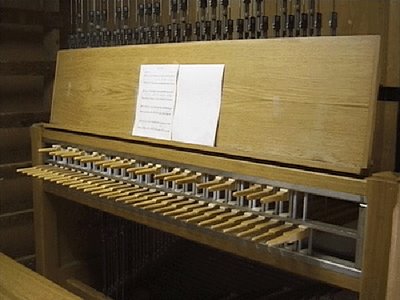
Carillon bells are bolted to steel or wooden beams and do not move in performance. Instead, the clappers, which are connected by a direct mechanical linkage to the keys of the keyboard, move to strike the bell. The carillon's mechanical playing action, like that of the piano, gives the performer the ability to control dynamics and phrasing by variation of touch. Diagram of a carillon action
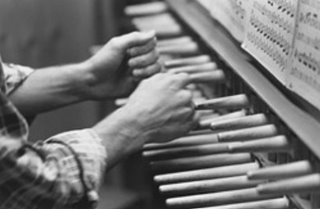 Although the traditional carillon keyboard (sometimes called a clavier) shares some similarities with other keyboard instruments, performance technique is unique to the carillon. The keyboard has a manual key (played by the hand) for each note in the carillon. These keys are sometimes called batons because they are wooden levers about 2 feet in length, and rounded at the playing end, resembling batons. In addition, there are one to two octaves of pedal keys, played with the feet, that pull down the corresponding manual keys. This permits a performer to play the heavy bass bells with the feet, while still using hands in the middle and upper octaves. Up to six bells can thus be sounded at once. Generally it is not musically desirable to do so, however, because the rich overtone structure of bells produces a muddy, dense effect when too many are sounded at once.
Although the keys are played with a closed fist, the carillonneur does not "pound" or "beat" the keys. A properly adjusted and maintained carillon allows the performer to play with a minimum of effort.
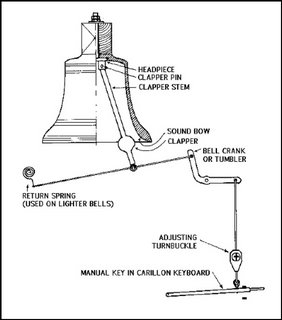 The motion of the key is carried to the bell's clapper by a wire, usually stainless steel. In the bell chamber the wire is attached to a transmission system that transfers the motion from a vertical wire to a horizontal wire that pulls the bell's clapper (see illustration). At rest, the clapper is about 2 inches from the bell wall. Immediately above the key is an adjuster that allows the performer to compensate for changes in wire length due to temperature changes.
The keyboard should be located close to the bells to keep the mechanical connections short allowing for more precise playing. When the keyboard is too far from the bells, the mass of long wires keeps the clapper against the bell too long, deadening the sound. On large bells, gravity is sufficient to pull the clapper back from the bell; for smaller bells, return springs are needed to pull the clapper back quickly.
While at first glance it may seem that an electric mechanism may be better than a mechanical action, no electrical system has yet been developed which permits expression through variation of touch, as required for proper musical performance. Electrical strikers hit the bell with the same force every time, so none of the great dynamic range of the bell is available to the performer. In addition, such actions are less reliable, and more expensive, than mechanical action.
Some carillons have automatic mechanisms that act as clock chimes, playing the Westminster Quarters or other tunes and striking the hour. Electric action is well suited to such simple tunes. Occasionally, three to five bass bells are arranged to swing in a peal. The sound of such a peal is glorious, but outside clappers must then be used for the carillon action. If this not done carefully, these bells can be more difficult to play than the rest of the carillon.
-- Link to online original.
*

Carillon bells are bolted to steel or wooden beams and do not move in performance. Instead, the clappers, which are connected by a direct mechanical linkage to the keys of the keyboard, move to strike the bell. The carillon's mechanical playing action, like that of the piano, gives the performer the ability to control dynamics and phrasing by variation of touch. Diagram of a carillon action
 Although the traditional carillon keyboard (sometimes called a clavier) shares some similarities with other keyboard instruments, performance technique is unique to the carillon. The keyboard has a manual key (played by the hand) for each note in the carillon. These keys are sometimes called batons because they are wooden levers about 2 feet in length, and rounded at the playing end, resembling batons. In addition, there are one to two octaves of pedal keys, played with the feet, that pull down the corresponding manual keys. This permits a performer to play the heavy bass bells with the feet, while still using hands in the middle and upper octaves. Up to six bells can thus be sounded at once. Generally it is not musically desirable to do so, however, because the rich overtone structure of bells produces a muddy, dense effect when too many are sounded at once.
Although the keys are played with a closed fist, the carillonneur does not "pound" or "beat" the keys. A properly adjusted and maintained carillon allows the performer to play with a minimum of effort.
 The motion of the key is carried to the bell's clapper by a wire, usually stainless steel. In the bell chamber the wire is attached to a transmission system that transfers the motion from a vertical wire to a horizontal wire that pulls the bell's clapper (see illustration). At rest, the clapper is about 2 inches from the bell wall. Immediately above the key is an adjuster that allows the performer to compensate for changes in wire length due to temperature changes.
The keyboard should be located close to the bells to keep the mechanical connections short allowing for more precise playing. When the keyboard is too far from the bells, the mass of long wires keeps the clapper against the bell too long, deadening the sound. On large bells, gravity is sufficient to pull the clapper back from the bell; for smaller bells, return springs are needed to pull the clapper back quickly.
While at first glance it may seem that an electric mechanism may be better than a mechanical action, no electrical system has yet been developed which permits expression through variation of touch, as required for proper musical performance. Electrical strikers hit the bell with the same force every time, so none of the great dynamic range of the bell is available to the performer. In addition, such actions are less reliable, and more expensive, than mechanical action.
Some carillons have automatic mechanisms that act as clock chimes, playing the Westminster Quarters or other tunes and striking the hour. Electric action is well suited to such simple tunes. Occasionally, three to five bass bells are arranged to swing in a peal. The sound of such a peal is glorious, but outside clappers must then be used for the carillon action. If this not done carefully, these bells can be more difficult to play than the rest of the carillon.
-- Link to online original.
*

Pittis Carillon - Trevor Workman - Carillonneur to Bournville Village Trust [England]
*

Trevor was appointed by Bournville Village Trust as Carillonneur in 1965 upon the retirement of Clifford Ball, who had occupied the position, gaining a world wide reputation as master of the carillon, since 1924.
At the time of his appointment, Trevor was already an accomplished pianist and had throughout childhood years been a regular prize winner at local and National Competitive Music Festivals. In his teens, Trevor won a scholarship for piano tuition at the renowned Birmingham Conservatoire and for many years was a student under concert pianist William Fellowes. Trevor has always enjoyed a full and varied musical leisure time having given frequent solo performances on the piano and organ, and also being accompanist to numerous vocalists, instrumentalists, and choirs over many years.
Over the past five years Trevor has become more widely known as a carillonneur on the world stage, having represented Great Britain in five Eurocarillon Festivals. He likewise participated in the recital programme of the 10th World Carillon Congress held in Aschaffenburg, Germany in 1996 and in the 11th Congress in Mechelen, Belgium in 1999.
On that occasion he played the famous carillon of St Rombouts Cathedral, Mechelen. This location in Belgium was significant in that it is the home of the Royal Carillon School where Clifford Ball, Carillonneur in Bournville for more than 40 years, received tuition and gained his Diploma in the Carillon art.
In recent years Trevor has been on recital tours in Germany, France, Belgium the Netherlands and Denmark, and in February 1998, he was a guest recitalist in the International Carillon Festival at Bok Tower Gardens, Lake Wales, Florida and was privileged to play the beautiful Taylor Carillon installed in the Singing Tower.
Trevor Workman released a recording of the Bournville Carillon in 1996 entitled Celebration (Sounds of Bournville) and is seeking to promote better understanding and appreciation of the instrument in Britain. He gives regular weekly carillon recitals at Bournville, seeking to maintain the highest standards of playing enjoyed by the locality since the carillon was installed by George Cadbury in 1906.
Trevor hopes to continue his carillon career for many more years, seeking not only to enrich his experience by visiting and playing other carillons at home and abroad, but also to promote the carillon in England by encouraging interest from members of the general public, staging special events, and making the carillon more accessible to visitors.
There have been a number of special events in Bournville in the past three years when the Carillon has been featured in a remarkable way utilising closed circuit television. Eminent carillonneurs from abroad have taken part with Trevor on these special occasions and the Eurocarillon 2000 Festival will once again encompass occasions when modern technology will bring the carillon art to the general public in a way that has hitherto been impossible.
-- Online link.
*
Friday, August 25, 2006
Housing - NY Times - Krugman: Housing gets ugly
*
Published in the New York Times, Friday, August 25, 2006
Op-Ed Columnist
Housing Gets Ugly
By PAUL KRUGMAN
Bubble, bubble, Toll’s in trouble. This week, Toll Brothers, the nation’s premier builder of McMansions, announced that sales were way off, profits were down, and the company was walking away from already-purchased options on land for future development.
Toll’s announcement was one of many indications that the long-feared housing bust has arrived. Home sales are down sharply; home prices, which rose 57 percent over the past five years (and much more than that along the coasts), are now falling in much of the country. The inventory of unsold existing homes is at a 13-year high; builders’ confidence is at a 15-year low.
A year ago, Robert Toll, who runs Toll Brothers, was euphoric about the housing boom, declaring: “We’ve got the supply, and the market has got the demand. So it’s a match made in heaven.” In a New York Times profile of his company published last October, he dismissed worries about a possible bust. “Why can’t real estate just have a boom like every other industry?” he asked. “Why do we have to have a bubble and then a pop?”
The current downturn, Mr. Toll now says, is unlike anything he’s seen: sales are slumping despite the absence of any “macroeconomic nasty condition” taking housing down along with the rest of the economy. He suggests that unease about the direction of the country and the war in Iraq is undermining confidence. All I have to say is: pop!
Now what? Until recently most business economists were predicting a “soft landing” for housing. Even now, the majority opinion seems to be that we’re looking at a cooling market, not a bust. But this complacency looks increasingly like denial, as hard data — which tend, for technical reasons, to lag what’s actually going on in the market — start to confirm anecdotal evidence that it is, indeed, a bust.
Why the sudden crackup? When prices were rising rapidly, some people bought houses purely as investments, betting that prices would keep going up. Other people rushed to buy houses, or stretched themselves to buy houses they couldn’t really afford, because they feared that prices would rise out of reach if they waited. And all this speculative demand pushed prices even higher. In other words, there was a market bubble.
But eventually prices reached a level beyond what even optimistic potential buyers were willing to pay, especially after interest rates rose a bit. (They’re still low by historical standards.) As demand fell short of supply, double-digit price increases declined into the low single digits, then went negative everywhere except in the South.
And with prices falling in many areas, the speculative demand for houses has gone into reverse, as people try to get out with a profit while they still can. There’s now a rapidly growing glut of unsold houses. This is a recipe for a major bust, not a soft landing.
Moreover, it could be both a deep and a prolonged bust. Since 2000, much of the nation has experienced a rise in home prices comparable to the boom in Southern California during the late 1980’s. After that bubble popped, Los Angeles house prices began a slow, grinding deflation, eventually falling 20 percent (34 percent after adjusting for inflation). Prices didn’t begin a sustained recovery until 1996, more than six years after the downturn began.
Now imagine the same thing happening across a large part of the United States. It’s an ugly picture, and not just for people and companies in the construction business. Many homeowners — especially those who bought their houses with interest-only loans or with minimal down payments — will find themselves in financial distress. And the economy as a whole will take a hit.
As far as I know, Nouriel Roubini of Roubini Global Economics is the only well-known economist flatly predicting a housing-led recession in the coming year. Most forecasters consider his call alarmist, and many Federal Reserve officials remain optimistic. Last week, Richard Fisher, the president of the Federal Reserve Bank of Dallas, dismissed “Eeyores in the analytical community” who worry about a possible recession.
Call me Eeyore. While I don’t share Mr. Roubini’s certainty, I see his point: housing has been the main engine of U.S. economic growth over the past three years, and with that engine now going into reverse, it’s hard to see how we can avoid a serious slowdown.
Link to online story.
(Note: Online stories may be taken down by their publisher after a period of time or made available for a fee. Links posted here is from the original online publication of this piece.)
(In accordance with Title 17 U.S.C. Section 107, this material is distributed without profit to those who have expressed a prior interest in receiving the included information for research and educational purposes. Plainfield Today, Plainfield Stuff and Clippings have no affiliation whatsoever with the originator of these articles nor are Plainfield Today, Plainfield Stuff or Clippings endorsed or sponsored by the originator.)
*
Thursday, August 24, 2006
House Tour - September 10, 2006
*
PLAINFIELD PRESENTS THE FIRST OPEN HOUSE TOUR
OF ALL SIX RESIDENTIAL HISTORIC DISTRICTS
SUNDAY, SEPTEMBER 10, 2006
SELF-GUIDED TOUR 11 A.M. TO 4 P.M.
$20 TICKETS AVAILABLE BEFORE THE 10TH AT:
- SWAIN GALLERY, 703 WATCHUNG AVENUE, PLAINFIELD
- QUEEN CITY DINER (formerly Rena's), 1324 SOUTH AVENUE, PLAINFIELD
- MEEKER'S FLORIST, 427 SOUTH AVENUE, PLAINFIELD
- CENTURY 21- LOU POMPILIO, 223 PARK AVENUE, SCOTCH PLAINS
$25 TICKETS SOLD DAY OF THE TOUR AT
Netherwood Train Station,
South Ave @ Belvidere Ave, Plainfield
Sunday, September 10, 2006, 10:30 a.m to 2 p.m.
For the first time since Plainfield’s first historic district was formed in the late 1970s, during the early days of historic preservation, a self-guided house tour has been organized which features eleven (11) homes located in ALL of the City’s residential historic districts. In addition to Crescent Area, Van Wyck Brooks, Hillside Avenue, Putnam-Watchung, Netherwood Heights, and Broadway Districts are represented. Also included is the Society of Friends (Quaker) Meeting House, which adjoins the seven block commercail North Avenue Historic District. Built in 1788, it has been used as a religious facility continuously since then. As tour goers venture toward the Meeting House, they will pass the Plainfield Civic Historic District, which includes City Hall, the War Memorial and other historic municipal structures.
Rashid Burney, City Councilman said, "We are showcasing the architectural heritage of our City and the committment of all of our citizens to putting their best foot forward, thereby improving the quality of all our lives." William Michelson, attorney and urban planner said, "the house tours have traditionally been the life blood of the historic districts, which, in turn, have been the life blood of Plainfield."
DESCRIPTION OF EACH HISTORIC DISTRICT:
Crescent Area was the first historic district registered by the City. It was built in the 1870s as a planned development of upscale residences. Job Male, Plainfield’s first mayor, resided there. The district contains a variety of Victorian styles including Italianate and Second Empire.
Named after the Pulitzer Prize-winning author and resident, Van Wyck Brooks, the District is the largest of the historic districts and is famous for the stunning brick Victorian homes that capture the exuberance of the "High Victorian Era" of the late 1800s. Another characteristic are the many outbuildings, such as stables and carriage barns.
The Hillside Avenue District features imposing homes built at the turn of the 20th Century and its generous lots and wide street lend an air of gracious luxury. Colonial Revival style architecture predominates, along with examples of Queen Anne and Shingle style homes.
The Putnam-Watchung District primarily contains houses built as single-family dwellings by the affluent middle-class during the emerging commuter era at the turn of the 20th Century. The homes typify the Late-Victorian and Edwardian designs popular between 1875 and 1925.
The Netherwood Heights District is another early planned community and features homes built between 1875 and 1910. Originally dominated by the Netherwood Hotel, development follows the natural contours of the hilly terrain. The Tudor Revival homes in the district were built in the 1920s and ‘30s, after the demise of the Hotel, during the period of Northern New Jersey’s rapid suburban growth.
Watchung Avenue was originally called Broadway, hence the District’s name. It features substantial single-family residences built between 1895 and 1910 during Plainfield’s height of development as an affluent railroad commuter suburb. Shingle style and Colonial Revival architecture define the character of the district.
PLEASE JOIN US ON THE TOUR AND THANK YOU FOR YOUR SUPPORT!!!
Information: (908) 769-0636
Redevelopment - Map - Cottage Place/East 3rd/Richmond Street
*
Map of the area between Roosevelt Avenue and Richmond Street, and East 2nd Street and the NJT right of way.
Click on map to enlarge.
The Administration's proposed study area is in yellow. PT's MODEST PROPOSAL is in green.
 *
Map of the area between Roosevelt Avenue and Richmond Street, and East 2nd Street and the NJT right of way.
Click on map to enlarge.
The Administration's proposed study area is in yellow. PT's MODEST PROPOSAL is in green.

Wednesday, August 23, 2006
Casablanca - I'm shocked!
*
From Casablanca (1942).
Captain Renault (Claude Rains) threatens to close up Rick's (Humphrey Bogart) Blue Parrot club.
*
From Casablanca (1942).
Captain Renault (Claude Rains) threatens to close up Rick's (Humphrey Bogart) Blue Parrot club.
Rick: How can you close me up? On what grounds?
Captain Renault: I'm shocked, shocked to find that gambling is going on in here!
[a croupier hands Renault a pile of money]
Croupier: Your winnings, sir.
Captain Renault: [sotto voce] Oh, thank you very much.
[aloud] Everybody out at once!
*
Pay-to-Play - Courier Post - County party committees an issue
*
Published in the Courier-Post, Wednesday, August 23, 2006
Pay-to-play reform unsettled
By JIM WALSH
Courier-Post Staff
COLLINGSWOOD
Borough commissioners gave preliminary approval to two pay-to-play reform measures Monday, but the vote didn't end a dispute over the best way to limit political contributions.
An activists' group that held a successful petition drive to place an alternate measure on the November ballot said it was not prepared to withdraw its proposal.
"Our initial reaction is that we're disappointed," said resident Kevin Madden, a member of the petition group.
"We're going to review the ordinance and make a decision (on whether to withdraw) this week."
Both sides would limit contributions to local candidates by professionals, such as engineers and architects, who might later seek contracts with the borough.
But they split over how to handle professionals' contributions to county-level political committees.
The activists' measure -- a model ordinance created by a Middlesex County nonprofit and adopted by 40 municipalities -- would bar professionals from borough contracts if they give more than $500 a year to a county-level political organization.
"Collingswood is enmeshed in a county political system," said Madden.
But Mayor M. James Maley Jr. said that language would force the borough to replace professionals who have brought "substantial success to the borough over the past 10 years."
The commissioners' measure instead would allow county organizations to donate only $500 a year to local candidates or their committees.
"Our measure actually strengthens this," said Maley, noting the activists' proposal would not limit the flow of funds from county organizations.
"To us, there's no connection between someone making contributions to the county and doing work with Collingswood," he added.
But Madden said he believed professionals could be found who did not make political contributions.
The measure will stay on the ballot if the activists' group, called the Committee of Five, does not withdraw it within 10 days, Commissioner Michael Hall said Monday.
That decision would require approval by four of the committee's five members, said activist Eleanor Vine.
She noted more than 600 borough residents signed a petition in support of the ordinance. If the ordinance were to be withdrawn at Monday's meeting, she said, "the voters of Collingswood would be bypassed, losing their voice on this important issue."
PT asks: Why not both restrictions?
Link to online story.
(Note: Online stories may be taken down by their publisher after a period of time or made available for a fee. Links posted here is from the original online publication of this piece.)
(In accordance with Title 17 U.S.C. Section 107, this material is distributed without profit to those who have expressed a prior interest in receiving the included information for research and educational purposes. Plainfield Today, Plainfield Stuff and Clippings have no affiliation whatsoever with the originator of these articles nor are Plainfield Today, Plainfield Stuff or Clippings endorsed or sponsored by the originator.)
*
Published in the Courier-Post, Wednesday, August 23, 2006
Pay-to-play reform unsettled
By JIM WALSH
Courier-Post Staff
COLLINGSWOOD
Borough commissioners gave preliminary approval to two pay-to-play reform measures Monday, but the vote didn't end a dispute over the best way to limit political contributions.
An activists' group that held a successful petition drive to place an alternate measure on the November ballot said it was not prepared to withdraw its proposal.
"Our initial reaction is that we're disappointed," said resident Kevin Madden, a member of the petition group.
"We're going to review the ordinance and make a decision (on whether to withdraw) this week."
Both sides would limit contributions to local candidates by professionals, such as engineers and architects, who might later seek contracts with the borough.
But they split over how to handle professionals' contributions to county-level political committees.
The activists' measure -- a model ordinance created by a Middlesex County nonprofit and adopted by 40 municipalities -- would bar professionals from borough contracts if they give more than $500 a year to a county-level political organization.
"Collingswood is enmeshed in a county political system," said Madden.
But Mayor M. James Maley Jr. said that language would force the borough to replace professionals who have brought "substantial success to the borough over the past 10 years."
The commissioners' measure instead would allow county organizations to donate only $500 a year to local candidates or their committees.
"Our measure actually strengthens this," said Maley, noting the activists' proposal would not limit the flow of funds from county organizations.
"To us, there's no connection between someone making contributions to the county and doing work with Collingswood," he added.
But Madden said he believed professionals could be found who did not make political contributions.
The measure will stay on the ballot if the activists' group, called the Committee of Five, does not withdraw it within 10 days, Commissioner Michael Hall said Monday.
That decision would require approval by four of the committee's five members, said activist Eleanor Vine.
She noted more than 600 borough residents signed a petition in support of the ordinance. If the ordinance were to be withdrawn at Monday's meeting, she said, "the voters of Collingswood would be bypassed, losing their voice on this important issue."
IF YOU GOReach Jim Walsh at (856) 486-2646 or jwalsh@courierpostonline.com
The borough commission will hold a second reading on its proposed pay-to-play ordinance Sept. 5 at 7 p.m. in the Community Center, 30 W. Collings Ave.
PT asks: Why not both restrictions?
Link to online story.
(Note: Online stories may be taken down by their publisher after a period of time or made available for a fee. Links posted here is from the original online publication of this piece.)
(In accordance with Title 17 U.S.C. Section 107, this material is distributed without profit to those who have expressed a prior interest in receiving the included information for research and educational purposes. Plainfield Today, Plainfield Stuff and Clippings have no affiliation whatsoever with the originator of these articles nor are Plainfield Today, Plainfield Stuff or Clippings endorsed or sponsored by the originator.)
*
Monday, August 21, 2006
Policing - Courier - Plainfield and selected towns, 2005 vs 2004
*
-- Dan Damon
Not getting your own CLIPPINGS email daily? Click here to get started.
| Police Departments by male and female officers and civilian employess, 2004 to 2005. | ||||||||||||
| TOWN | MALE OFFICERS | CHANGE | FEMALE OFFICERS | CHANGE | CIVILIAN | CHANGE | TOTAL | CHANGE | ||||
| 2004 | 2005 | 2004 | 2005 | 2004 | 2005 | 2004 | 2005 | |||||
| Plainfield | 135 | 134 | -1 | 16 | 18 | 2 | 26 | 31 | 5 | 177 | 183 | 6 |
| North Plainfield | 47 | 45 | -2 | 1 | 1 | 0 | 6 | 5 | -1 | 54 | 51 | -3 |
| Watchung | 27 | 28 | 1 | 1 | 0 | -1 | 7 | 7 | 0 | 35 | 35 | 0 |
| Scotch Plains | 41 | 42 | 1 | 2 | 2 | 0 | 7 | 7 | 0 | 50 | 51 | 1 |
| Fanwood | 21 | 21 | 0 | 0 | 0 | 0 | 1 | 1 | 0 | 22 | 22 | 0 |
| South Plainfield | 52 | 53 | 1 | 2 | 2 | 0 | 15 | 17 | 2 | 69 | 72 | 3 |
| Piscataway | 84 | 86 | 2 | 6 | 6 | 0 | 20 | 19 | -1 | 110 | 111 | 1 |
| Dunellen | 16 | 17 | 1 | 0 | 0 | 0 | 4 | 4 | 0 | 20 | 21 | 1 |
| Green Brook | 21 | 22 | 1 | 0 | 0 | 0 | 6 | 6 | 0 | 27 | 28 | 1 |
From: Courier News, Sunday, August 20, 2006. Source: NJ State Police Crime Reports. | ||||||||||||
-- Dan Damon
Not getting your own CLIPPINGS email daily? Click here to get started.
Sunday, August 20, 2006
Iraq War - Austin Statesman - Sheehan group protests Rove appearance
Published in the Austin American-Statesman, Sunday, August 20, 2006
Rove rallies Texas Republican stalwarts
Cindy Sheehan protests Austin appearance by presidential adviser

By W. Gardner Selby
AMERICAN-STATESMAN STAFF
After protesters allied with anti-war demonstrator Cindy Sheehan rushed the ballroom doors and scuffled with police, senior White House adviser Karl Rove roused Republicans Saturday in Austin by suggesting that a strong economy and President Bush's course abroad will lead GOP candidates to November wins.
Saying Democrats are pro-taxation, pro-spending and wrongly committed to cutting and running from Iraq, the chief White House political adviser said: "We are right, and they are wrong."
One protester managed to slip inside the event, which attracted more than 300 guests and raised an estimated $250,000 for the Associated Republicans of Texas.
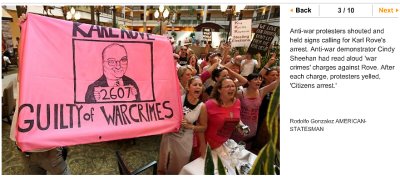
Shouting objections, including "men and women are dying," the woman was escorted from the ballroom of the Renaissance Austin Hotel.
Laughter came after Rove said: "I don't question the patriotism of our critics. Many are hard-working public servants who are doing the best they can. Some of them are people looking for a free meal."
Rove also posed an unanswered query to Pat Robbins, the GOP group's executive director: "Pat, did you get her check before she left?"
Protesters began gathering outside the hotel well before Rove slipped in through a side door for a pre-dinner private reception. Waving handwritten signs, about 50 chanted, "Get out of town, Karl. Get out, get out."
Several dozen protesters entered the hotel and briefly unfurled a pink banner from a balcony that read "Rove v. Truth No Contest. Pink Slip Rove."
After GOP supporters entered the ballroom to dine and hear Rove, protesters surged to within several feet of the room's doors, which hotel employees held shut.
One protester momentarily entered the ballroom and yelled, "Karl Rove is a war criminal!" She was hauled out.
Outside the room, police demanded that protesters leave the hotel.
Scuffling between protesters and Austin police led Sheehan's sister, DeDe Miller, to fall backward to the carpeted floor.
One protester was arrested, Austin police said.
Cindy Sheehan also read aloud "war crimes" charges against Rove, including a charge that Rove was responsible for her son's 2004 death as an Army specialist in Iraq. After each charge, protesters yelled, "Citizens arrest."
Police detained Tiffany Burns of Los Angeles, who has been Sheehan's press representative. Burns said she was handcuffed after she asked officers to arrest Rove.
Inside the ballroom, Rove said Democratic leaders in Congress have not come to terms with the necessity of continuing the conflict in Iraq.
"Democrats cannot support the goal of victory while opposing the means necessary to achieve it. And it is fiction and fantasy to pretend otherwise," he said.
"If leading Democrats have their way, their policies would make our nation weaker and the enemies of our nation would be stronger. That is a stark fact of modern life, and it is the issue on which the forthcoming election should center," Rove said.
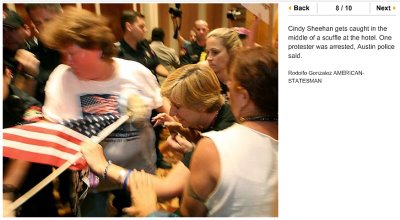
Among the protesters was Linda Foley of Azle near Fort Worth.
"This is just one more thing we do when we're trying to change administration policy," she said.
Foley, who wore peace-sign earrings and a Veterans for Peace shirt, said she and others had caravaned from Camp Casey near President Bush's ranch outside Crawford south of Waco. The camp is named after Sheehan's late son, Casey.
Several dozen protesters remained on the street outside the hotel.
Rove, 55, is a Utah native best known as Bush's political guru. His career as a Republican political consultant took shape in Texas starting in the late 1970s when he coached Bush, then of Midland, in an unsuccessful U.S. House bid.
Rove built a business centered on sending fundraising appeals and candidate leaflets by mail. He advised Dallas oilman Bill Clements in his upset of Democrat John Hill for governor in 1978, subsequently helping many candidates end a century of Democratic dominance in state offices.
Republicans cheering him Saturday included Land Commissioner Jerry Patterson, who presented Rove with a flak jacket.
"He takes a lot of shots from virtually everyone," Patterson announced.
Rove gave thanks, and also accepted Patterson's offer to mail the jacket to Washington.
Link to online story.
(Note: Online stories may be taken down by their publisher after a period of time or made available for a fee. Links posted here is from the original online publication of this piece.)
(In accordance with Title 17 U.S.C. Section 107, this material is distributed without profit to those who have expressed a prior interest in receiving the included information for research and educational purposes. Plainfield Today, Plainfield Stuff and Clippings have no affiliation whatsoever with the originator of these articles nor are Plainfield Today, Plainfield Stuff or Clippings endorsed or sponsored by the originator.)
*
Rove rallies Texas Republican stalwarts
Cindy Sheehan protests Austin appearance by presidential adviser

By W. Gardner Selby
AMERICAN-STATESMAN STAFF
After protesters allied with anti-war demonstrator Cindy Sheehan rushed the ballroom doors and scuffled with police, senior White House adviser Karl Rove roused Republicans Saturday in Austin by suggesting that a strong economy and President Bush's course abroad will lead GOP candidates to November wins.
Saying Democrats are pro-taxation, pro-spending and wrongly committed to cutting and running from Iraq, the chief White House political adviser said: "We are right, and they are wrong."
One protester managed to slip inside the event, which attracted more than 300 guests and raised an estimated $250,000 for the Associated Republicans of Texas.

Shouting objections, including "men and women are dying," the woman was escorted from the ballroom of the Renaissance Austin Hotel.
Laughter came after Rove said: "I don't question the patriotism of our critics. Many are hard-working public servants who are doing the best they can. Some of them are people looking for a free meal."
Rove also posed an unanswered query to Pat Robbins, the GOP group's executive director: "Pat, did you get her check before she left?"
Protesters began gathering outside the hotel well before Rove slipped in through a side door for a pre-dinner private reception. Waving handwritten signs, about 50 chanted, "Get out of town, Karl. Get out, get out."
Several dozen protesters entered the hotel and briefly unfurled a pink banner from a balcony that read "Rove v. Truth No Contest. Pink Slip Rove."
After GOP supporters entered the ballroom to dine and hear Rove, protesters surged to within several feet of the room's doors, which hotel employees held shut.
One protester momentarily entered the ballroom and yelled, "Karl Rove is a war criminal!" She was hauled out.
Outside the room, police demanded that protesters leave the hotel.
Scuffling between protesters and Austin police led Sheehan's sister, DeDe Miller, to fall backward to the carpeted floor.
One protester was arrested, Austin police said.
Cindy Sheehan also read aloud "war crimes" charges against Rove, including a charge that Rove was responsible for her son's 2004 death as an Army specialist in Iraq. After each charge, protesters yelled, "Citizens arrest."
Police detained Tiffany Burns of Los Angeles, who has been Sheehan's press representative. Burns said she was handcuffed after she asked officers to arrest Rove.
Inside the ballroom, Rove said Democratic leaders in Congress have not come to terms with the necessity of continuing the conflict in Iraq.
"Democrats cannot support the goal of victory while opposing the means necessary to achieve it. And it is fiction and fantasy to pretend otherwise," he said.
"If leading Democrats have their way, their policies would make our nation weaker and the enemies of our nation would be stronger. That is a stark fact of modern life, and it is the issue on which the forthcoming election should center," Rove said.

Among the protesters was Linda Foley of Azle near Fort Worth.
"This is just one more thing we do when we're trying to change administration policy," she said.
Foley, who wore peace-sign earrings and a Veterans for Peace shirt, said she and others had caravaned from Camp Casey near President Bush's ranch outside Crawford south of Waco. The camp is named after Sheehan's late son, Casey.
Several dozen protesters remained on the street outside the hotel.
Rove, 55, is a Utah native best known as Bush's political guru. His career as a Republican political consultant took shape in Texas starting in the late 1970s when he coached Bush, then of Midland, in an unsuccessful U.S. House bid.
Rove built a business centered on sending fundraising appeals and candidate leaflets by mail. He advised Dallas oilman Bill Clements in his upset of Democrat John Hill for governor in 1978, subsequently helping many candidates end a century of Democratic dominance in state offices.
Republicans cheering him Saturday included Land Commissioner Jerry Patterson, who presented Rove with a flak jacket.
"He takes a lot of shots from virtually everyone," Patterson announced.
Rove gave thanks, and also accepted Patterson's offer to mail the jacket to Washington.
Link to online story.
(Note: Online stories may be taken down by their publisher after a period of time or made available for a fee. Links posted here is from the original online publication of this piece.)
(In accordance with Title 17 U.S.C. Section 107, this material is distributed without profit to those who have expressed a prior interest in receiving the included information for research and educational purposes. Plainfield Today, Plainfield Stuff and Clippings have no affiliation whatsoever with the originator of these articles nor are Plainfield Today, Plainfield Stuff or Clippings endorsed or sponsored by the originator.)
*
Book Review - WashPost - Juan Williams: Enough
*
Published in the Washington Post [Book World], Sunday, August 20, 2006
Is Bill Cosby Right?
Help thyself, a black social critic says to the upcoming generations.
Reviewed by Peniel E. Joseph
Sunday, August 20, 2006; BW10
More than 40 years later, prophets such as Baldwin have all but vanished from intellectual discourse, replaced by a chorus of commentators whose gaze has turned decidedly inward. Lacking the political courage and personal compassion to confront the racism, segregation, poverty and violence that so disturbed Baldwin, these post-civil rights critics observe that, for black people, the enemy is us.
Juan Williams, an NPR analyst and former Washington Post reporter, joins a growing line of such fed-up liberals and disappointed progressives (including scholar Orlando Patterson and entertainer Bill Cosby) who find the state of much contemporary black life alarming and more than a little embarrassing, considering the gains of the civil rights movement.
Williams believes that the 1954 Brown school-desegregation decision and subsequent activism and legislation virtually cured the disease of racism; that heroic era was a 20th-century watershed. For him, the remedies for racism's remaining vestiges are education, self-determination and individual responsibility. Regarding political leaders in the 21st century, he prefers mavericks in the mold of Bill Cosby, whom he considers courageous enough to "call out" the predatory behavior of the black poor. On this score, Williams laments what he sees as a black underclass mesmerized by racial hucksters playing "old school" politics: corporate blackmail disguised as boycotts, naked shakedowns leveraged by rhetorical threats and the like.
Occasionally the depth of historic and contemporary institutionalized racism faced by blacks creeps into Williams's discussion, but he is more concerned with what he perceives as black apathy and self-destructive behavior. This is disappointing: A discussion of post-civil rights racism would have added nuance to Enough 's criticism of contemporary black leadership, reparations, public schools, criminality and culture.
For Williams, Cosby stands out as a prophet amid a searing American wilderness: bold enough to expose the rough truth that individual responsibility is more responsible than "systemic racism" for black crime, educational shortcomings and bad behavior. In Cosby's speeches and Williams's book, fleeting acknowledgments of racism are trumped by simplistic, at times repetitive lectures cautioning blacks to look at their own shortcomings before blaming anyone else.
Beyond Williams's polemics lies a more complex story about the political economy of racism whose effects on poor neighborhoods elude those who romanticize ghetto and "gangsta" culture. His discussions of the "stop snitching" campaigns that discourage cooperation with police and Cosby's outrage over the epidemic use of the "N" word are worthy of serious debate. But that would require the kind of rich analysis, penetrating insight and layered narrative that Enough lacks, as well as a hard look at the impacts of unemployment, racial profiling, police brutality and other features of modern-day racism, along with the lingering effects of slavery and Jim Crow, which continue to disfigure the lives of blacks and distort the shape of American democracy.
Unlike The Covenant With Black America , a bestselling anthology with concrete proposals for community empowerment, Enough concludes with a flurry of righteous condescension, preaching that youngsters can best avoid poverty by finishing high school, getting a job and postponing marriage and child-bearing until at least 21. Williams's praise for African Americans' creative resilience during the rough road from slavery to freedom is commendable, as is his ardor for the achievements of civil rights activists. But even as civil rights victories opened doors of opportunity, white backlash, the decline of industrial jobs and fatigue over racial conflict helped blunt the movement's more ambitious dreams: ending poverty, forging genuine racial integration and eliminating social, political and economic disparities based on race.
Like many storytellers, Williams imagines that his subject, the civil rights movement, had a beginning, a middle and an end. But it may be closer to the truth to regard the civil rights victories of the 1960s as only a historic chapter in America's unfinished saga of racial struggle.
Peniel E. Joseph, who teaches in the Department of Africana Studies at Stony Brook University, is the author of "Waiting 'Til the Midnight Hour: A Narrative History of Black Power in America."
Link to online story.
(Note: Online stories may be taken down by their publisher after a period of time or made available for a fee. Links posted here is from the original online publication of this piece.)
(In accordance with Title 17 U.S.C. Section 107, this material is distributed without profit to those who have expressed a prior interest in receiving the included information for research and educational purposes. Plainfield Today, Plainfield Stuff and Clippings have no affiliation whatsoever with the originator of these articles nor are Plainfield Today, Plainfield Stuff or Clippings endorsed or sponsored by the originator.)
*
Published in the Washington Post [Book World], Sunday, August 20, 2006
Is Bill Cosby Right?
Help thyself, a black social critic says to the upcoming generations.
Reviewed by Peniel E. Joseph
Sunday, August 20, 2006; BW10
ENOUGHIn 1963 James Baldwin emerged as an oracle on race relations in the service of transforming American democracy. A masterpiece of criticism, The Fire Next Time cast Baldwin as a modern-day Jeremiah warning the nation against impending doom posed by segregation, institutional racism and white supremacy. "Time catches up with kingdoms and crushes them," he cautioned.
The Phony Leaders, Dead-End Movements, and Culture of Failure
That Are Undermining Black America -- and What We Can Do About It
By Juan Williams. Crown. 243 pp. $25
More than 40 years later, prophets such as Baldwin have all but vanished from intellectual discourse, replaced by a chorus of commentators whose gaze has turned decidedly inward. Lacking the political courage and personal compassion to confront the racism, segregation, poverty and violence that so disturbed Baldwin, these post-civil rights critics observe that, for black people, the enemy is us.
Juan Williams, an NPR analyst and former Washington Post reporter, joins a growing line of such fed-up liberals and disappointed progressives (including scholar Orlando Patterson and entertainer Bill Cosby) who find the state of much contemporary black life alarming and more than a little embarrassing, considering the gains of the civil rights movement.
Williams believes that the 1954 Brown school-desegregation decision and subsequent activism and legislation virtually cured the disease of racism; that heroic era was a 20th-century watershed. For him, the remedies for racism's remaining vestiges are education, self-determination and individual responsibility. Regarding political leaders in the 21st century, he prefers mavericks in the mold of Bill Cosby, whom he considers courageous enough to "call out" the predatory behavior of the black poor. On this score, Williams laments what he sees as a black underclass mesmerized by racial hucksters playing "old school" politics: corporate blackmail disguised as boycotts, naked shakedowns leveraged by rhetorical threats and the like.
Occasionally the depth of historic and contemporary institutionalized racism faced by blacks creeps into Williams's discussion, but he is more concerned with what he perceives as black apathy and self-destructive behavior. This is disappointing: A discussion of post-civil rights racism would have added nuance to Enough 's criticism of contemporary black leadership, reparations, public schools, criminality and culture.
For Williams, Cosby stands out as a prophet amid a searing American wilderness: bold enough to expose the rough truth that individual responsibility is more responsible than "systemic racism" for black crime, educational shortcomings and bad behavior. In Cosby's speeches and Williams's book, fleeting acknowledgments of racism are trumped by simplistic, at times repetitive lectures cautioning blacks to look at their own shortcomings before blaming anyone else.
Beyond Williams's polemics lies a more complex story about the political economy of racism whose effects on poor neighborhoods elude those who romanticize ghetto and "gangsta" culture. His discussions of the "stop snitching" campaigns that discourage cooperation with police and Cosby's outrage over the epidemic use of the "N" word are worthy of serious debate. But that would require the kind of rich analysis, penetrating insight and layered narrative that Enough lacks, as well as a hard look at the impacts of unemployment, racial profiling, police brutality and other features of modern-day racism, along with the lingering effects of slavery and Jim Crow, which continue to disfigure the lives of blacks and distort the shape of American democracy.
Unlike The Covenant With Black America , a bestselling anthology with concrete proposals for community empowerment, Enough concludes with a flurry of righteous condescension, preaching that youngsters can best avoid poverty by finishing high school, getting a job and postponing marriage and child-bearing until at least 21. Williams's praise for African Americans' creative resilience during the rough road from slavery to freedom is commendable, as is his ardor for the achievements of civil rights activists. But even as civil rights victories opened doors of opportunity, white backlash, the decline of industrial jobs and fatigue over racial conflict helped blunt the movement's more ambitious dreams: ending poverty, forging genuine racial integration and eliminating social, political and economic disparities based on race.
Like many storytellers, Williams imagines that his subject, the civil rights movement, had a beginning, a middle and an end. But it may be closer to the truth to regard the civil rights victories of the 1960s as only a historic chapter in America's unfinished saga of racial struggle.
Peniel E. Joseph, who teaches in the Department of Africana Studies at Stony Brook University, is the author of "Waiting 'Til the Midnight Hour: A Narrative History of Black Power in America."
Link to online story.
(Note: Online stories may be taken down by their publisher after a period of time or made available for a fee. Links posted here is from the original online publication of this piece.)
(In accordance with Title 17 U.S.C. Section 107, this material is distributed without profit to those who have expressed a prior interest in receiving the included information for research and educational purposes. Plainfield Today, Plainfield Stuff and Clippings have no affiliation whatsoever with the originator of these articles nor are Plainfield Today, Plainfield Stuff or Clippings endorsed or sponsored by the originator.)
*
Crime - Courier - Editorial: No crime news is good news
*
Published in the Courier News, Wednesday, August 16, 2006
[Editorial]
No crime news is good news in Plainfield
We haven't been hearing much about crime trends in Plainfield lately, good news in a city where a string of murders so dominated the headlines a year ago.
Recent reports of the decline in homicides through July this year over the same period in 2005 (from 11 to six) were certainly welcome, but city administration officials wisely didn't go overboard in praising their own efforts. The impression is of leaders well aware of the long and difficult law enforcement task ahead.
Most striking in all of this, however, is the absence of discontented voices -- at least publicly -- that had been so prevalent in the final years of former Mayor Al McWilliams' administration. Whether it was rank-and-file police officers blasting city officials, administration officials criticizing police department leadership, or the mayor and City Council bickering over whom to blame for police layoffs, everyone, it seemed, was pulling in a different crime-fighting direction.
That has mostly changed under Mayor Sharon Robinson-Briggs, who enjoyed the support of the police union during last year's campaign and has put in place some of her own people to help steer the police department.
There are five more officers on the force. Redeployment of personnel has created 18 additional officers available for regular patrol. City officials also credit greater cooperation with county and state law enforcement agencies for assisting their cause. One such example is an upcoming anti-gang initiative, Operation Cease Fire, in which a state trooper will assist in training a special unit to specifically target gun violence in the city.
Just having everyone on the same page doesn't by itself guarantee success. The right decisions have to be made. Some of the slings and arrows suffered by McWilliams resulted from his reasonable attempts to shake up the status quo, attempts that are being carried through in some fashion under Robinson-Briggs. (The redeployment to increase patrols, for instance, was initiated under McWilliams.) Some dissatisfaction with bold steps isn't to be feared.
But the combustible mix of a rash of murders and a contentious political campaign helped turn the law enforcement debate ugly in 2005. The absence of that ugliness is a refreshing -- and promising -- change in 2006.
Link to online story.
(Note: Online stories may be taken down by their publisher after a period of time or made available for a fee. Links posted here is from the original online publication of this piece.)
(In accordance with Title 17 U.S.C. Section 107, this material is distributed without profit to those who have expressed a prior interest in receiving the included information for research and educational purposes. Plainfield Today, Plainfield Stuff and Clippings have no affiliation whatsoever with the originator of these articles nor are Plainfield Today, Plainfield Stuff or Clippings endorsed or sponsored by the originator.)
*
Crime - Courier - City wants crime to be trend
*
Published in the Courier News, Tuesday, August 15, 2006
City wants crime dip to be a lasting trend
By CHRISTA SEGALINI
Staff Writer
PLAINFIELD -- Coming off a record year for homicides -- 15 in 2005 -- Plainfield police officials said they were bracing for the possibility that violent crimes would spike this year.
But by August, Plainfield has seen fewer homicides than it did by the same time last year. There have been six killings in the city so far this year, compared with 11 by August 2005.
Officials are quick to deflect suggestions of a trend. Homicides, they said, are difficult to predict or generalize. But increased police presence on the streets and local cooperation with county and state law enforcement agencies are being hailed as steps toward a safer Plainfield.
"We're trying a more proactive approach to crime, and I think it's working," said Martin Hellwig, Plainfield's director of public safety. "For a long time, the city was being very reactionary, and it wasn't doing anything."
After a reorganization of the city's police department earlier this year and the addition of five police officers to a force of almost 150 people, the city now has 18 more uniformed police officers in patrol cars. The addition, Hellwig said, brings the city's number of patrol officers to 88.
"We have had a lot of success with the new patrol model, and we're actually catching people on the street after they commit crimes," Hellwig said. "Obviously, we're happy about that."
Some residents said they have noticed more police cars circling their neighborhoods -- a welcomed sign of change, they said, but not proof of a complete turnaround.
"You can see more police, that's true," said resident Alea Jackson, 37. "But do I feel safer? No."
Officials admit that in a city with an estimated 500 gang members, increased police presence alone doesn't change annual crime statistics.
"Plainfield this year had six homicides, which is fortunately a lower rate than last year, and that's great, but what concerns us is that four of those six involved gangs," Union County Prosecutor Theodore J. Romankow said.
"The statewide average is that 12 percent of homicides be gang related, and Plainfield is at 66 percent," he said.
Romankow and Hellwig both said the Plainfield Police Department has been working closely with the Union County Prosecutor's Office throughout the past few months targeting the city's gangs and drug rings -- considered by officials to be the primary source of Plainfield's violent crimes.
The crackdown, Romankow said, is supplemented by severe sentences for those convicted of gang and drug involvement.
But it's a program set to kick-off this fall -- Operation Cease Fire -- that has officials really buzzing with promise for the city.
"The community is outraged in Plainfield; they are upset and they want law enforcement to help them," Romankow said. "Cease Fire is meant to reduce gun violence by stopping the next shooting. We know that gun violence is something the community wants us to respond to, and through Cease Fire, we think we can do it."
Cease Fire works by placing a state trooper in the Plainfield Police Department who will assess the department's training, personnel and equipment needs, Romankow said. The city will locate centers of gang and drug activity -- many of which exist in Plainfield's West End, Romankow said.
A state police-trained unit will be formed to patrol the hot spot areas and treat every incident of gun shots fired as a homicide investigation, even when there is no victim.
"Handguns -- we know there are a limited number of people that use handguns, so we want to focus in on them," Romankow said.
With much of the success of the program hinging on community support -- witnesses to crimes informing police of what they've seen -- Romankow said getting the community on board and informed about the program is of high importance to law enforcement.
"This program is working in Irvington, where there's been a 25 percent reduction in shootings in the city's target zones," Romankow said of Cease Fire. "Because of that, it's gained significant community support, which I hope is what happens here."
Christa Segalini can be reached at (908) 707-3142 or csegalini@c-n.com
Link to online story.
(Note: Online stories may be taken down by their publisher after a period of time or made available for a fee. Links posted here is from the original online publication of this piece.)
(In accordance with Title 17 U.S.C. Section 107, this material is distributed without profit to those who have expressed a prior interest in receiving the included information for research and educational purposes. Plainfield Today, Plainfield Stuff and Clippings have no affiliation whatsoever with the originator of these articles nor are Plainfield Today, Plainfield Stuff or Clippings endorsed or sponsored by the originator.)
*
Saturday, August 19, 2006
Letter - Courier - Editorial Ignores Dem Machine
*
Published in the Courier News, Saturday, August 19, 2006
[Letter to Editor]
Editorial on city ignores (Democratic) machine
Thank you for the recent editorial citing the apparent decline in crime in Plainfield. However, your conclusion that the "good news" is due to the new administration's abillity to get everyone to work together is a bit misplaced.
You correctly cite that the redeployment of police to increase patrols was initiated under Mayor Albert T. McWilliams and that he successfully fought to "shake up the status quo." You seemed to forget that McWilliams sought and received a review of the police department from the state, which was highly critical of the "top heavy" department and its past practices of having so many seasoned police sitting around in headquarters.
It is my understanding that most of the state's recommendations were put in place. It was this push from the past administration for these officers (most of whom do not live in Plainfield) to do their job that caused the "rank-and-file police officers to blast city officials."
While you indicate that "some dissatisfaction with bold steps" is acceptable, you seem to applaud the "absence of discontented voices" saying it is a "promising change." Many of us in Plainfield do not agree. Our apprehension with the current government which seems to be so clearly "working together" is just that.
With the death of Ray Blanco, there is no one who dares speak out and question the Democratic machine that runs our city and county. The selection by the Democratic committee to replace Blanco with Harold Gibson, rather than the qualified but independent Hispanic, Christian Estevez, is just another example of the lack of democracy that appears to be the current status quo in Plainfield.
Mr. Gibson, as brother of former Newark Mayor Ken Gibson and currently Union County public safety director, is clearly a Democratic party insider. I've lived in Plainfield for more than 20 years and have been a member of the Democratic party for more than 30 years. My husband and I sought out this city to raise our children and we choose to stay here. However, the city can only thrive if its government is more than a jobs program or a guaranteed Democratic party voting block.
COLLEEN CATTAFE
Plainfield
Link to online story.
(Note: Online stories may be taken down by their publisher after a period of time or made available for a fee. Links posted here is from the original online publication of this piece.)
(In accordance with Title 17 U.S.C. Section 107, this material is distributed without profit to those who have expressed a prior interest in receiving the included information for research and educational purposes. Plainfield Today, Plainfield Stuff and Clippings have no affiliation whatsoever with the originator of these articles nor are Plainfield Today, Plainfield Stuff or Clippings endorsed or sponsored by the originator.)
*
Wednesday, August 16, 2006
Farber resignation - PoliticsNJ - Selected items
*
Selections from the PoliticsNJ blog for Tuesday, August 15, 2006
Governor Jon Corzine on the resignation of Zulima Farber: "I have an important and painful announcement that the Attorney General and I have come to accept. After thoughtful consideration, the Attorney General has decided to resign her position.
I want to thank Attorney General Farber for her cooperation and candor at every stage of this difficult process. Today, as always, she has sought to put the best interests of the state and the high responsibilities of her office above any personal considerations.
As Attorney General, she has served for seven months with great effectiveness and success, as demonstrated by her restoring working relationships among the people involved in homeland security and preparedness, her strong leadership in bringing gang prosecutions and attacking gang violence, her personal efforts in representing the state before the Supreme Court in crucial litigation, and the reinvigorated professionalism of the Attorney General's Office.
The Attorney General has decided to resign effective August 31st. We both wish that her term had been longer.
Her decision to resign her office is painful for many. She has decided to do more than might ordinarily be required for a lapse in judgment, and to make a larger, personal sacrifice for the greater good. And let me be clear: this is her decision.
Public service - perhaps especially in New Jersey in this era - requires a willingness to make sacrifices. People give up larger incomes; they forgo time with their families; they endure long hours; and they put their reputations at risk.
The pressure is constant and the best among us demonstrate grace under that pressure. That is what Zulima Farber has done in this case. She is giving up a lifelong dream in order to serve the greater good -- in order to demonstrate by her actions that we expect the highest possible standards for those who serve.
While Zulima Farber has been a strong and effective Attorney General, the report from would inevitably impair that effectiveness and risk undermining an office that we both care about deeply. She recognizes that. I recognize that.
I regret that she will no longer be in my cabinet. But I know that she will continue to make significant contributions both to me and to the state in the future. While the Attorney General and I agree that it is not possible for her to continue in her current capacity, she still has much to offer our state under different circumstances. I look forward to continuing to work with her on various matters in the years to come.
I am grateful for her service." (08/15/06)
-------------------------------------------------------------------
U.S. Senator Robert Menendez on the resignation of Zulima Farber: "Zulima Farber made a decision in the best interests of the state. She has been a tenacious and effective Attorney General, and I am not surprised that in response to the special prosecutor’s report, she put service above self. She should be commended for acting quickly and sparing the state from protracted proceedings and petty partisan posturing. As a former public advocate, counsel to a governor, and a prosecutor, Zulima Farber has been a faithful public servant for many years, and I wish her well.” (08/15/06)
-------------------------------------------------------------------
The Associated Press is reporting that Zulima Farber will resign as Attorney General at 6PM. (08/15/06)
Sen. Robert Menendez says he hopes that Attorney General Zulima Farber "will act according to the best interests of the state." In a statement released this afternoon, Menendez said: " “The special prosecutor’s report concludes that while the Attorney General did not break the law, she did violate the state’s code of ethics. The public has a right to expect that government officials uphold the highest standards of integrity, and these offenses are serious. A cabinet member can only perform the duties of their office if they have the full confidence of the governor and the public. I hope the Attorney General will act according to the best interests of the state." (08/15/06)"
-------------------------------------------------------------------
Union County Republican Chairman Phil Morin wants an investigation of Union County Freeholder Angel Estrada's role in helping the Attorney General's live-in boyfriend restore his drivers license. Estrada is the manager of the state Motor Vehicle Commission office in Elizabeth, where Hamlet Goore went to address issues with his license. Special Prosecutor Richard Williams said in his report that "Mr. Estrada's handling of this matter before Hamlet Goore arrived at the MVC agency raises questions about the propriety of his practices and whether they were in compliance with MVC procedures.
"While Judge Williams stated that he did not have jurisdiction to investigate Freeholder Estrada's conduct, the MVC should," said Morin. "After all the Chief Administrator of the MVC, Sharon Harrington, is also an appointee to Governor Corzine's State Ethics Commission." (08/15/06)
-------------------------------------------------------------------
Senate Judiciary Committee Chairman John Adler has become the first prominent Democrat to call for Attorney General Zulima Farber's resignation. "Today's report from a special prosecutor, appointed by Governor Corzine to investigate the traffic-stop incident, has shattered hopes that Zulima Farber would raise the office of Attorney General to a level of integrity and excellence that we have a right to expect," Adler said.
"The report concludes that she violated the State's ethics code, and breached the public trust."
"Zulima Farber must resign. The Office of Attorney General cannot rebound from ethics violations with her at the helm. We need an Attorney General who is above reproach," said Adler. "I pray that she does not put her personal interest ahead of the public interest." (08/15/06)
-------------------------------------------------------------------
U.S. Senate candidate Tom Kean Jr. is calling on Sen. Robert Menendez to state his position on a Farber resignation. “After enduring the ethical scandals of Jim McGreevey and Bob Torricelli, New Jerseyans are now being forced to put up with the embarrassment of Zulima Farber, said Kean. "It’s no wonder that Bob Menendez is hiding from this issue. After all, it was Menendez who fought unsuccessfully to get Farber a seat on the state Supreme Court, and then championed her appointment to the Attorney General post." (08/15/06)
Link to online story.
(Note: Online stories may be taken down by their publisher after a period of time or made available for a fee. Links posted here is from the original online publication of this piece.)
(In accordance with Title 17 U.S.C. Section 107, this material is distributed without profit to those who have expressed a prior interest in receiving the included information for research and educational purposes. Plainfield Today, Plainfield Stuff and Clippings have no affiliation whatsoever with the originator of these articles nor are Plainfield Today, Plainfield Stuff or Clippings endorsed or sponsored by the originator.)
*
Subscribe to:
Posts (Atom)